
Blog
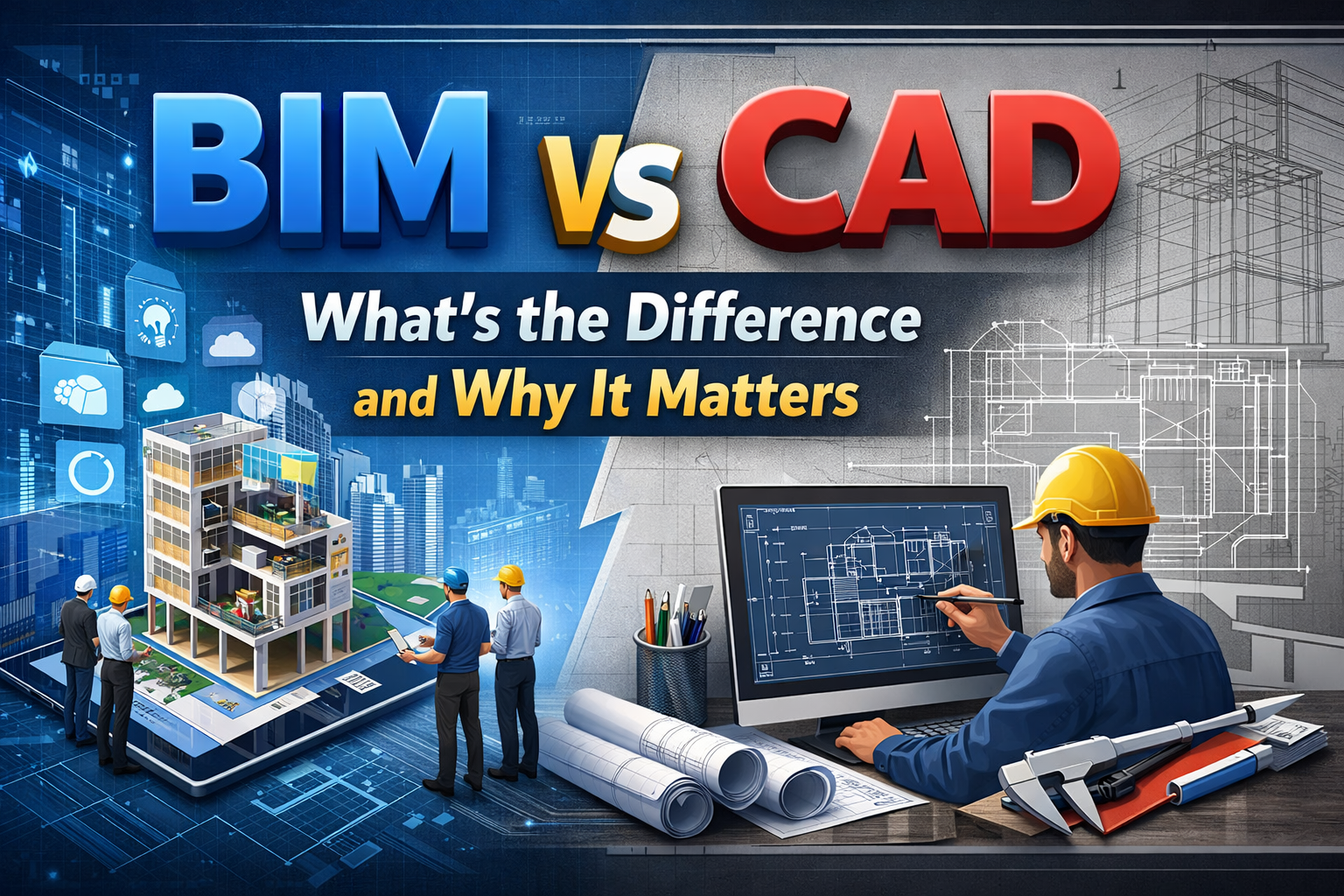
BIM VS CAD: WHAT'S THE DIFFERENCE AND WHY IT MATTERS
The construction, architecture, and engineering industries have undergone a massive digital transformation over the past few decades. From manual drafting to advanced digital modeling, technology has reshaped how buildings are designed, analyzed, and constructed. Two of the most widely used technologies in this space are CAD (Computer-Aided Design) and BIM (Building Information Modeling). While many professionals use these terms interchangeably, they are fundamentally different in purpose, capability, and impact.
Understanding the difference between BIM and CAD is essential for students, architects, engineers, and construction professionals who want to stay competitive in today’s fast-evolving industry. This blog explores what sets BIM apart from CAD and why choosing the right skillset often through the Best BIM training institute in Kerala can be a game-changer for your career.
What Is CAD?
CAD, or Computer-Aided Design, has been a cornerstone of the design industry for decades. It is primarily used to create 2D drawings and basic 3D models of buildings and components. CAD software replaces traditional hand drafting with precise digital drawings, making the design process faster and more accurate.
Key Features of CAD:
- Produces 2D plans, sections, and elevations
- Limited intelligence elements are just lines and shapes
- Changes must be manually updated across drawings
- Primarily used for drafting and documentation
While CAD is still widely used, especially for smaller projects, it lacks the ability to manage complex building data and coordination across multiple disciplines.
What Is BIM?
BIM, or Building Information Modeling, goes far beyond drafting. It is a process that creates an intelligent 3D model containing detailed information about every element of a building. A BIM model is not just a visual representation it includes data related to materials, quantities, cost, scheduling, and performance.
Key Features of BIM:
- Intelligent 3D models with embedded data
- Automatic coordination across disciplines
- Real-time updates across all views
- Supports lifecycle management (design, construction, and maintenance)
BIM enables collaboration between architects, engineers, contractors, and facility managers, making it a powerful tool for modern construction projects.
BIM vs CAD: Key Differences
Data Intelligence
CAD drawings consist of lines and shapes with no built-in intelligence. In contrast, BIM objects “know” what they are. A wall in BIM understands its height, thickness, material, and cost, making data extraction effortless.
Coordination and Collaboration
With CAD, each discipline works on separate drawings, increasing the risk of errors and clashes. BIM allows multiple teams to work on a single coordinated model, detecting conflicts early and saving time and money.
Change Management
In CAD, changes must be updated manually in every drawing, which can lead to inconsistencies. In BIM, a change made once is automatically reflected in plans, sections, schedules, and quantities.
Project Lifecycle Support
CAD is mainly limited to the design stage. BIM supports the entire building lifecycle, from conceptual design and construction planning to facility management and renovations.
Cost and Time Efficiency
BIM enables accurate quantity takeoffs, cost estimation, and construction sequencing (4D and 5D BIM), helping reduce rework, delays, and budget overruns, something CAD cannot offer effectively.
Why BIM Matters in Today’s Industry
The global construction industry is rapidly adopting BIM due to its ability to improve efficiency, reduce errors, and enhance collaboration. Governments and large infrastructure projects increasingly mandate BIM usage, making it a must-have skill rather than an optional one.
In India, BIM adoption is growing across sectors such as infrastructure, real estate, and smart city projects. Professionals skilled in BIM have a significant advantage over those who rely solely on CAD.
Career Opportunities: BIM vs CAD
While CAD skills are still relevant, especially for entry-level roles, BIM professionals enjoy broader and more future-proof career opportunities.
BIM Roles Include:
- BIM Modeler
- BIM Coordinator
- BIM Engineer
- BIM Manager
These roles often offer higher salaries, global opportunities, and faster career growth compared to traditional CAD drafting roles.
Why Learning BIM Is a Smart Choice
Transitioning from CAD to BIM is one of the best career decisions a design or construction professional can make. BIM skills are in high demand across architecture, structural engineering, MEP, and construction management fields.
Choosing the Best BIM training institute in Kerala ensures:
- Industry-oriented curriculum
- Hands-on project experience
- Guidance from industry experts
- Placement support and career mentoring
Kerala has emerged as a strong hub for technical education, and quality BIM training here can open doors to both national and international job markets.
Conclusion
While CAD and BIM both play important roles in the construction industry, they serve very different purposes. CAD focuses on drafting, whereas BIM focuses on information-rich modeling and collaboration. As the industry moves toward smarter, more efficient workflows, BIM is clearly the future.
For students and professionals looking to stay ahead, learning BIM is no longer optional, it’s essential. Enrolling in the Best BIM training institute in Kerala can provide the skills, confidence, and industry exposure needed to thrive in this competitive field.